Showing posts with label therapeutic fiction. Show all posts

Friday, October 4, 2019

The Remarkable Journey of Coyote Sunrise


This middle grade novel by Dan Gemeinhart, was wonderful. Read it. That is all.

Just kidding, you know I can't stop there. This compelling story chronicles the 5 year physical and emotional journey of 12 year-old Coyote Sunrise and her father Rodeo.

Coyote shares their story with the reader and it is immediately apparent that she is independent, intelligent, and street smart. She reveals herself to us slowly, peeling away the layers of street tough and pain, and as she does, we begin to understand how she and Rodeo came to live in a renovated school bus, driving from place to place on their wims.

Coyote and her grandmother, who lives in Washington, speak on the phone every Sunday, and it is during one of those calls that Coyote discovers that the neighborhood park she loved as a little girl is being bulldozed to become a parking lot. This news catapults Coyote into action and we soon learn that 5 years ago, she, her mother, and her two sisters buried a time capsule of sorts in that park and Coyote, who is, at the moment, in Florida, is determined to get back to Washington and retrieve the box before it disappears forever.

But, there is a considerable obstacle - Rodeo. He refuses to return to their hometown, or even speak of it. So how will Coyote convince him to take her back to Washington and save the time capsule in less than a week? No spoilers here.

As the will-they-get-there tension rises, Coyote begins to confront her past and, in turn, forces Rodeo to do the same. A cast of characters joins them as they cross the United States and each one adds depth to the story and introduces the reader to some of the tough topics and difficult choices we must make in life. One of the key events toward the resolution seemed a bit far-fetched to me, but it did make for an exciting chapter.

I love the way Gemeinhart resolved their story. With no shortage of events on both the rising and falling action sides of the story arc spectrum, it could have ended up in numerous ways, but his ending is satisfying and will help middle grade readers feel closure.

His books deal with tough subjects and this one is no different - mental health, death, parentification, breaking up with someone you love, coming out, dishonesty, and domestic abuse are all touched on in this novel. The difference between Gemeinhart and many other MG authors is that while he does not sugar coat things, he isn't graphic or offensive in the way he addresses the topics. If you'd like to hear him explain this, see the interview link below.

Researching Gemeinhart led me to the fact that he also lives in Washington, in the small town of Cashmere. He used to work as a teacher librarian, which gave him the opportunity to not only read tons of children's and teen literature, but gave him an inside look at what they like, what they are curious about, and the books that meet those needs.

Whether you choose a regular book, an e-book, or an audiobook, please read this story.

Dan Gemeinhart website
Interview with Dan Gemeinhart (scroll down for interview)
Interview with Dan Gemeinhart about his book Good Dog - it's a 27 minute segment, and worth watching, but if you want to hear his take on writing for middle graders, start at 9:26 and go to about 13:10.

Tuesday, April 30, 2019

The Rabbit Listened


     This book was sitting in our school library return basket today, and it caught my eye. I read it while waiting for my class to finish checking out books, and it completely bowled me over.

     Little Taylor is heartbroken when his beautiful creation gets knocked over. His animal friends come along one by one to offer their help and advice - one wants to talk it out, another wants to get angry, yet another encourages revenge, and, of course, one wants to fix it for him.

     But Taylor doesn't want or need to do any of those things. As he sits alone, struggling to figure things out, the rabbit sits down next to him and just listens.

     And that is exactly what Taylor needed.

    Doerrfeld is both author and illustrator of this simple story of loss and grief. She addresses the need to have someone just listen with clarity and honesty.


Cori Doerrfeld website
Brightly interview with Cori Doerrfeld
Drawing demo with Cori Doerrfeld

Tuesday, August 14, 2018

The Tiger Rising


Kate diCamillo is one of today's most popular junior fiction writers - great plots, engaging characters, challenging vocabulary, and abundant opportunities for inference and text connections.

Her best-known book is likely Because of Winn-Dixie, but she's also authored Flora and Ulysses, The Magician's Elephant, The Miraculous Journey of Edward Tulane, Raymie Nightengale, The Tale of Despereaux, as well as her Mercy Watson and Bink & Gollie series'.

I had the opportunity to hear her speak when she was touring to promote Flora and Ulysses, and she is thoroughly delightful. The audience was filled with all ages and she was engaging to every age and interest level. I've included link to interviews below and this article by her about why children's book SHOULD be a little bit sad is well worth your time.

Tiger Rising has a lot of sad, and it's ok. Rob's mother passed away a year ago. His dad is so grief-stricken that he won't talk about her and doesn't want anyone else to mention her either, including Rob. But their hometown full of people who love them and his mother insists on wrapping their arms around them, so his father decides they have to move.

Rob has an image in his mind of a suitcase, and he puts all of his feelings, thoughts, and memories of his mother into that suitcase and keeps the lid shut tight. He refers back to the suitcase anytime he is tempted to cry or even talk to anyone about his mother.

They end up living in a hotel where his father works as a handyman. Rob is bullied at school, on the bus, everywhere he goes, and adults turn a blind eye. He has a rash on his legs, that to any adult would signal emotional distress, but to other children represents another opportunity to mock and tease him. He adds his feelings about being treated this way to his suitcase.

And then Sistine moves to town. Sistine's parents recently divorced and she is sure her father is coming any day to take her to live with him, so she has no intention of making friends or caring about this place. Rob is drawn to her immediately.

Sistine immediately becomes a target for the other children, but she, unlike Rob, fights back, leaving school each day with dirty, torn clothes, as well as scrapes and bruises. Before she and Rob can get to know each other very well, his principal sends him home until the rash on his legs clears up because some of the other parents are afraid it is contagious. Rob is thrilled!

Sistine brings him the schoolwork he has missed each day and they develop an uneasy friendship that is cemented when he shares that he has found a tiger in a cage in the woods, a tiger that sits squarely on top of his suitcase, holding it closed.

As the mystery of the tiger unfolds, Rob and Sistine come to terms with the truths in their lives - Sistine's father is not coming to get her and Rob must learn to talk about his feelings if he is going to be healthy.

This is a great read-aloud with older children. I recommend reading to together because of some of the intense topics and feelings that are woven into this wonderful story. It opens the door to opportunities to talk about divorce, death, compassion, kindness, mental health, friendship, decision-making, etc...

The ending is satisfying, but leaves enough room for the reader to imagine what the future holds for Rob and his friend Sistine.

Tiger Rising and Kate diCamillo's other works are available on Amazon.


Reading Rockets interview with diCamillo
Candlewick Press interview with diCamillo

Wednesday, July 18, 2018

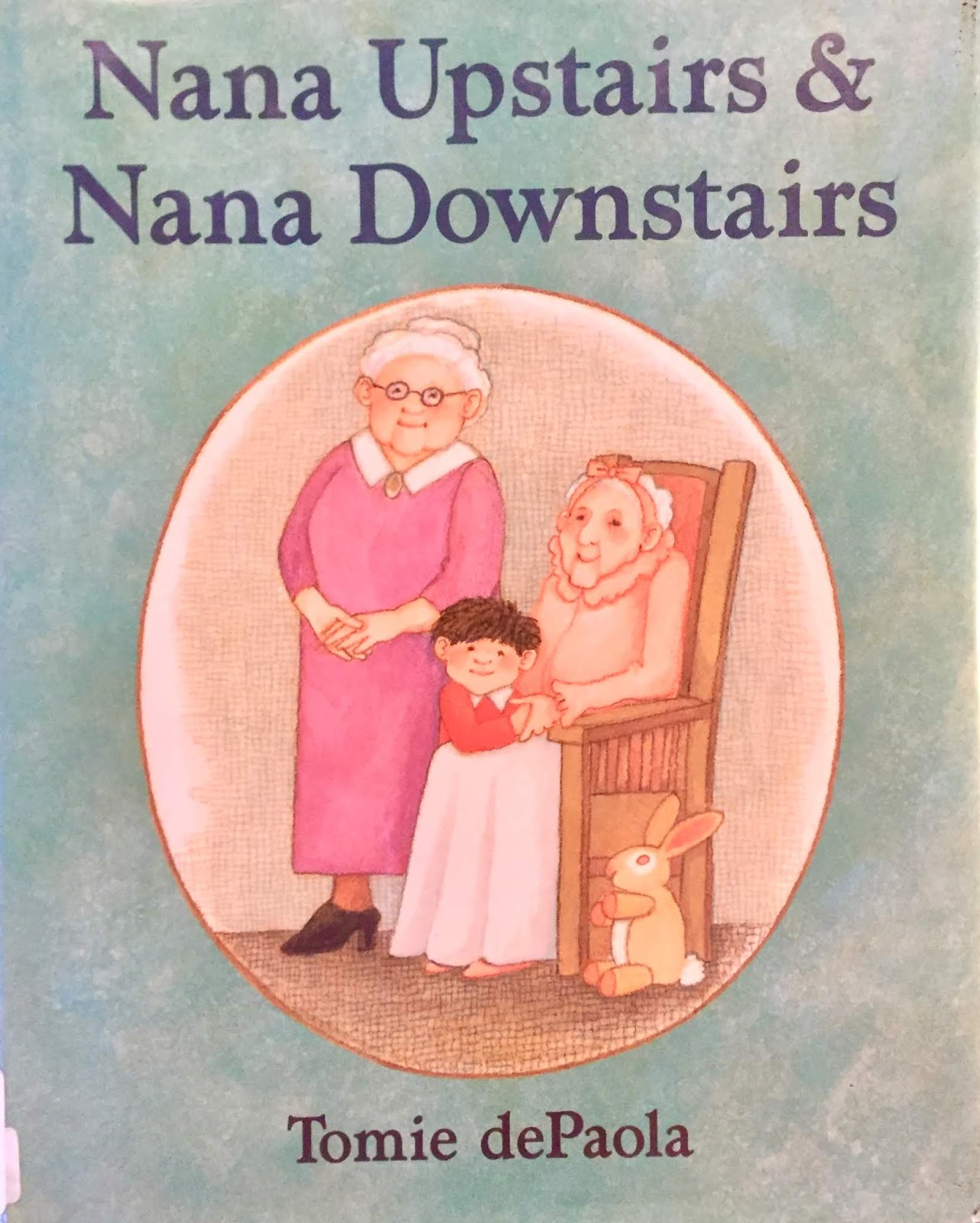
Nana Upstairs, Nana Downstairs


When you hear the name Tomie dePaola, chances are you think of Strega Nona, or one of his many holidays stories, but dePaola has written and/or illustrated 269 books (as of 4/3/2018), including a number of autobiographical stories about his life in a large, loving Irish-Italian family.

Nana Upstairs, Nana Downstairs is the sweet story of 4-year old Tomie and his relationships with his grandmother who lives downstairs, and his 94-year old great-grandmother, who lives upstairs.

dePaola shows us the tender care given to great-grandma by grandma and the entire family - brushing and braiding her hair each day, helping her to sit in her chair to visit with Tommy each day, feeding her, visiting with her, taking family photos, showing her the love and respect that aging parents need and deserve.

When Nana Upstairs passes away, Tommy struggles to understand what that means. dePaola takes readers through this delicate territory in a gentle, simple manner. It's no wonder that children are drawn to him and his stories.

Tomie dePaola's illustrations are distinctive and appear to be simple. In Tomie dePaola: His Art and Stories, Trina Schart Hyman tells about her attempt to duplicate a "Tomie drawing", thinking it would take 10-20 minutes tops. Six hours and 38 ruined pieces of paper later, she realized, "That seemingly formulaic style, with its simple line, its folksy composition, and its childlike color, was a lot more complex and sophisticated than I bargained for - and almost impossible to duplicate in spirit." 

Nana Upstairs, Nana Downstairs is available through Amazon.

Reading Rockets interview with Tomie dePaola
Tomie dePaola on why reading is important
Jim Henson Company video  - Strega Nona tells Tomie dePaola a story
Meet Tomie dePaola


Monday, May 7, 2018

Wilfrid Gordon McDonald Partridge


This beautifully illustrated story is another old favorite that I shared with my class today. I have several students with great-grandparents who are starting to lose their memories, something that often frightens children and/or causes them to question whether or not that grandparent still loves them if they can't remember them.

Wilfrid lives next door to a nursing home and befriends Miss Nancy, a 96-year old resident who is losing her memory. Wilfred wonders what that means and begins asking all his trusted adults, "What is a memory?" They give him a variety of answers, and he reflects on his own life to come up with a collection of items that represent his own memories. In the heartwarming conclusion, he shares his collection of memories with Miss Nancy since she has lost her own.

A great follow up to this story is this activity, a freebie for all you teachers out there - Happy Teacher Appreciation Week!
You can put them in pairs or small groups to share their memories, or use your fair sticks to call 2-3 students up to share for each category.

Australian author, Mem Fox, has a way of creating the sweetest stories that stay with you forever, and Julie Vivas, who has illustrated 4 of Fox's books, does a wonderful job of creating the colorful, folksy, family feel of the story. Fox's first book, Possum Magic, also illustrated by Vivas, was published in 1983 and became a bestseller. Her most recent book, I'm Australian Too, was published in 2017.

Fun Fact: Wilfrid Gordon McDonald Partridge is her father's name.

Storyline Online is a great resource - is your voice tired, do you need a few minutes to regroup, are they getting tired of hearing your voice? Try Storyline Online, a site which streams videos featuring celebrated actors reading children’s books. Readers include Viola Davis, Chris Pine, Lily Tomlin, Kevin Costner, Annette Bening, James Earl Jones, Betty White and dozens more.

Here's Wilfrid Gordon McDonald Partridge read by Bradley Whitford

Mem Fox talks to kids

Wednesday, April 25, 2018

Therapeutic Fiction


I've started a new hashtag on Instagram - #therapeuticfiction .

It's that time of year again, the time when we remember what the phrase "teacher tired" means. Students are antsy and sassy and exhausting. Those who have put in their best effort all year are tired, those who have spent the year piddling their own time, their classmates' time, and their teacher's time with constant disruptions are kicking it up a notch. It's EXHAUSTING.

I have to remind myself every year that they are feeling anxious about the coming changes. For some of them, school is their safe place and summer means instability and uncertainty. Some are worried because they are moving across town or even across the country, or will be far from home with a non-custodial parent for a month or two. Others, like my 4th graders, are anxious about moving to a new school.

We've been reading lots of picture books about strong emotions and new situations, something I do at the beginning of the school year as well. These books are WONDERFUL springboards for conversations about what is bothering children. In the past few days, I have learned so much about these children I thought I already knew so well!

  • "That happened to me," 
  • "I feel that way, too," 
  • "His parents are NEVER getting back together," 
  • "My parents got divorced without even asking me," 
  • "My brother doesn't even talk to me anymore. All he does is play video games," 
  • "I'm scared of that, too,"
Julia Cook is a former school counselor and teacher who writes about tough topics for kids - deployment, foster care, cancer, autism, executive function, and much more. She's written more than 60 books and they are teacher favorites! The two books pictured above are written by her and were our read alouds earlier this week. 

Wilma Jean the Worry Machine is about a girl who worries about EVERYTHING - this girl is a world class worrier, and nothing goes unnoticed or is too small for her to obsess over. Her mom finally snaps, consults every professional she can find and comes up with a plan to help Wilma figure out some strategies for tackling the things that are keeping her from living her life to the fullest.

Thanks for the Feedback...I Think was hilarious! R.J has no skills for handling either compliments or criticism. He also has trouble reading body language and sensing tone. When he is rude to his teacher during a parent-teacher conference, his parents take action and teach him some strategies for responding to others.

My class was keenly interested in the feedback story, which allowed us to have a interesting conversation about what feedback is and some appropriate ways to respond to it. 

I've taught a number of RJs over the years, and sadly, there are more of them in each class as the years roll by. Because they have no strategies for handling feedback, they immediately become defensive, argumentative and disrespectful. Thankfully, teachers have access to books like these to help children identify with characters and process solutions in a non-threatening way.

So...I'm going to keep posting my favorite titles for helping children learn to identify and handle strong emotions and new situations with the hashtag #therapeuticfiction. Join me and soon we'll have a tremendous list of teacher-tested and approved books on Instagram!


Friday, April 20, 2018

You've Got Dragons


Many of my students have been here since Preschool or Kindergarten. We know them, they feel comfortable and safe, we love them.

As we get closer to the end of the school year, many of our 4th graders start to feel anxious about moving to our intermediate (5th & 6th grade) school next year. All 3 of our elementary schools feed into the intermediate school, so they will be suddenly be little fish in a big pond, moving from teacher to teacher each day, recess and lunch time will look very different, and they will be trying to figure out the social aspects of their cohort.

Naturally, I started looking for picture books that address dealing with change, anxiety, etc... This nugget popped up in a couple of lists and our school library had it! I looked it over and wasn't sure how my students would respond, but I decided to use it as a read aloud and see what happened.

They were completely engaged! Nick Maland's dragons are not too scary, his children seem powerful, which perfectly supports the text. Kathryn Cave has done a tremendous job of using dragons as a metaphor for our individual challenges in life. I wondered if my students would understand that, and sure enough, the moment I finished reading it, two hands shot up in the air, both with the same question, "What do the dragons represent in this story?"

Me: What do YOU think they represent?
Student: Our problems.

BAM! We had the perfect jumping off point for a conversation about the dragons that 4th graders face and they had a lot to say. Interestingly, many of them named their siblings as dragons :), but by and large, they talked about pressure to do well in school, athletics, music, etc... was at the top of their lists. These are 9 and 10 year olds - NINE and TEN.

Someone brought up being the new kid at a new school and I had the opportunity to point out that every 5th grader will be the new kid at a new school next year and this is their chance to decide how they want their classmates to remember them years from now.

We have many read alouds and discussions ahead of us in the coming weeks, but I could not be more pleased with the outcome this picture book instigated.


Thursday, March 1, 2018

Come With Me


Another day, another lock-down. At least that's how it's starting to feel. Yesterday, we had a lock-down drill, something we do periodically during the school year. My class was in the gym for PE and I was sorely tempted to just keep working in my room, but I was obedient and followed all of the protocols. 

Thank goodness, because about 5 minutes after the all clear was given, we had a real lock-down. I sat in the corner of my room, in the dark, behind a rocking chair, texting my adult children to let them know that we were locked down and that I love them. (Sorry, folks, but if I'm going to die today, my last words are going to be words of love to my children.) Then I started to think about my students down in the gym - were they frightened, was anyone crying, what adults were with them, would they really be safe if there was an intruder? I never thought I would wish to be with 24 nine year-olds in the middle of a lock-down, but that's exactly how I felt.

Half an hour later, the all clear was called and I hurried to the gym to help the PE teacher get them to the bus. They were mostly in good spirits and there were lots of hugs. 

Today, we spent our Morning Meeting talking about their thoughts and feelings about the lock-down. Then we read this terrific book by Holly McGhee. The illustrations made it so readable. Often a tough subject is accompanied by photos or very realistic illustrations, but Pascal Limaitre creates an unintimidating canvas for children who are reading about a sensitive topic.


A young girl is troubled by the things she sees and hears happening in the world around her and asks her parents what she can do to make the world a better place. Each parent takes a turn with her by replying, "Come with me," and taking her to do an everyday activity, being friendly and kind to everyone along the way. I prefaced the reading by telling my students that I would cry as I read (they are used to this), and I did.

As the little girl goes about her daily activities with her parents McGhee uses these indescribably comforting and inspiring phrases:

"...that day they won a tiny battle over fear for themselves and for the people of the world," 

"..because one person doesn't represent a family or a race or the people of a land,"

and possibly my favorite, "They let her go, and sent a message to the world. They would not live in fear."

We talked about the fact that her parents weren't taking her to do unusual things, just the same old things they do day after day so that she would see that she could go on.

After we finished the reading, I had each of them write down one thing they can do to make the world a better place and put it on our Class Chat chart.


It made my heart happy to see them stopping by throughout the day to read the notes. A few of them even added another.


We were feeling pretty good about our morning. And then, we had another lock-down at lunch.

To be continued...

Monday, October 26, 2015

A Gift for Abuelita


It's an understatement to say that my life has been crazy lately.  I'm now teaching the English component of a multi-age Spanish Immersion program. I love a challenge and this new assignment fits the bill. Now that I'm out from under the heavy load that a teacher new to a site experiences, I can start posting again.

One of the fun things about teaching in this program is that I have the opportunity to participate in many experiences unique to Hispanic cultures. Before this week, I did not understand the purpose of the holiday The Day of the Dead, or el Dia de Los Muertos.  Since I was unfamiliar with its meaning, I'll admit to being a bit put off by both the name and the symbols associated with it. I'm not big on Halloween either, for the record. But now that our program is immersing itself in preparing for the big day, I find that I am touched and appreciative rather than apprehensive.

This afternoon, my teaching partner gave me a book to read to the first and second graders to help prepare them for our upcoming el Dia de los Muertos celebration.  She had read it to them in Spanish, but thought they might like to hear it in English for better comprehension.  And so, I began reading A Gift for Abuelita: Celebrating the Day of the Dead.

Sweet is the perfect adjective to describe this story. It begins with a young girl, Rosita and her grandmother having quiet, meaningful conversations as Abuelita teaches Rosita how to braid, make tortillas, tend a garden and many other tasks. When Abuelita becomes ill and passes away, Rosita misses her dearly.

As el Dia de Los Muertos approaches, the entire family begins to create their offerings -  remembrances for each of their loved ones who have passed. Rosita begins a braid for Abuelita.  It becomes clear as preparations are made that Rosita has misunderstood.the events of el Dia de Los Muertos and believes that Abuelita will be there, just as she was in life.

The family gathers to celebrate and Rosita keeps asking why Abuelita has not arrived yet.  Finally, her father realizes that Rosita doesn't understand and clarifies for her that Abuelita will not be there in person, but that Rosita will feel her spirit and know when she is there.

I fought tears throughout the story, but as the author describes Rosita's gift to her grandmother in tender detail and the moment when Rosita feels her near, I could not hold them back. While this is a fairly common occurrence for me, my new littles hadn't seen it yet.  Well, they saw it today and while it wasn't an "ugly cry," it was one of those squeaky, I-can-barely-read-aloud cries.  The good news is that this group of children understood what I meant when I explained the difference between my crying at that moment and crying because of anger, sadness, or pain. We had a great discussion, and several of them shared their personal experiences with crying because something sweet touches your heart.

I highly recommend this book - as an introduction to Day of the Dead or just to comfort a child who has recently lost a loved one.

Friday, October 25, 2013

Dear Mr. Henshaw


Dear Mr. Henshaw by beloved children's author Beverly Cleary, is a series of letters from young Leigh Botts to author Boyd Henshaw.  It begins in 2nd grade when Leigh writes to his favorite author about his favorite book by the same.  Each year, he repeats the process when this assignment comes up - same author, same book.  Finally, in 5th grade, when Leigh sends a series of 10 questions his teacher wants them to ask an author, Mr. Henshaw has had enough and replies with 10 questions of his own.

In the midst of all this pen-palling, Leigh's parents get divorced and he and his mother move to a different town, leaving Leigh to make new friends at a new school.  His dad, a truck driver, is never around, and his beloved dog, Bandit, is on the road with Dad. To top it off, someone is stealing all the good stuff out of his lunch. 

To put it mildly, Leigh is struggling. He continues to reach out to Mr. Henshaw periodically, and bless the author's heart, he recognizes a child's cry for help and occasionally writes back with encouragement and suggestions. As Leigh follows his counsel, he begins to come to terms with his new life and chart a course for his future.

Beverly Cleary writes children well.  She knows how they think, act, and feel and she carefully crafts the relationships between them and the adults in their lives.  With their guidance, Leigh trudges through his life changes and begins to solve his own problems and accept responsibility for his own happiness.

Kids need to know that they have lots of company in the worlds of single parent families and being the new kid at school, and Cleary doesn't shy away from the strong emotions involved in divorce or schoolyard embarrassments. Instead, she uses them to show children that they are not alone. In Leigh, they find a friend and, if my classes over the years are any indication, they find comfort in knowing that their trials are not only survivable, but become stepping stones to new possibilities.

If this book hits the spot for you, check out the sequel, Strider.